
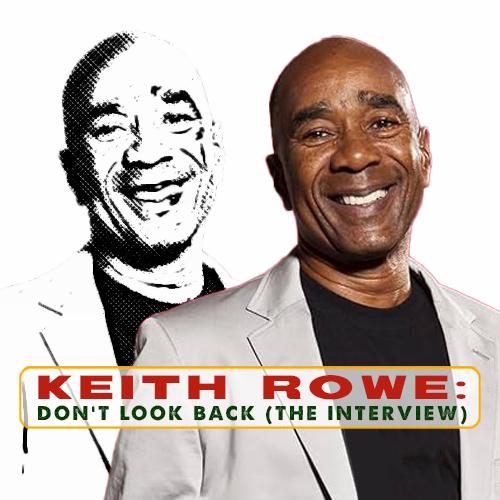
Interview with Keith Rowe (Keith & Tex)
Yep. That was the “New York Reggae Festival Song” for 1975.
Produced by one “F. Adams”?
No, “Franno” – Francis. “Franno” we called him, and he had a studio. He had a studio at Millwood Lane, or Millwood Street, in Brooklyn. That was my stable. I never ran around to different studios, never did that. Always found a home and messed it there. And I’d bring people in. But I never was one to run all over the place.
There’s another one… Did you have your own label at that time?
I had my own label, yeah. “KEBAR” – which is my name: Keith – Barrington – Rowe. Shortened to KEBAR. I did a few songs on that label.
So, you had ‘Best Time of My Life’, and ‘Cheating’ on DM for Denroy Morgan?
Uhm (laughs)… that’s a story! Yeah, I actually arranged that song for him. Took him to studio, and recorded it with some of the guys that I played with.
Is that you singin’ it?
Yeah, I had to sing it. I was forced into singin’ it! This is still early 70s… It was Denroy’s song but we had difficulty with him singing it. To not waste the entire session I laid the tracks down and then we released it. But, it was a tough recording session. Difficulty singin’ it, so… Without going into a lot of details, so we’ll leave it at that.
Then you had two titles like ‘Dearest Mother’, and ‘Quitting Is Tragic’ on the Turtle label?
I don’t remember ‘Dearest Mother’. ‘Quitting Is Tragic’, yeah. I remember that. But that label, no.
And there’s ‘I Nah Born Ya’, on KEBAR?
Right, right (laughs)! Yeah. That’s on the KEBAR label. That was in response to Ernie Smith’s… or was it Pluto Shervington’s ‘I Man On Ya’? Yeah, that was the answer to it – from a New York perspective (laughs)! I mean… “I man on ya, I’ve got to deal with what I’ve got here”. So that was my answer to his song.
Do you still got the mastertapes to those recordings?
I can put my hands on them, yeah. Actually I did have some others too that… my storage method was incorrect (laughs)! I didn’t have them in a real good storage location and the damn tapes got co-roaded. Lost those, yeah. It’s a pity. The technology… If I had DAT (Digital Audio Tape) at that time…! Oh, my God, y’know! I could put it in my computer now and have it for life, CDs, you know. I also had a master that was stolen out of a car. And never could put my hands on them again. Just lost music. Somebody broke into the car, stole all the records that we had, some vinyls pressed… just had done a pressing, y’know. Stole the vinyls and probably took the tapes away. Talk about… Oh man, I hurt for years! You see, you can read them songs, Peter, but you can’t get back vibes. I have done some music, man… that I have tried to redo, to no avail! Can’t get the vibe back. There was a certain sound and a certain feeling in the song. No matter how many times I’d redo, can’t get it, can’t get it… So if you lose it, you’d lost everything. You would never get “it” back. And I still have some recordings that was done from that time period. I have them and can get my hands on the masters, that’s gonna be on the next project that I’m releasing. Double-CD. You’ll see what I mean. It’s either the original or nothing (laughs)! I can’t redo them. I can’t… There’s something that you can add to help enhance it, or sweeten it. But you just can’t tamper with it.
Yeah, there’s so much unnecessary overdubs on old stuff . I mean, would you “update” a painting for example?
Yeah, you change the whole pace, that’s correct. If you touch it, man – it’s gone! It’s finished.
You decided, obviously, to go back to Jamaica, in the mid 70s. For what reason? When was your service in the military by the way?
Well, I joined the military ’72. I tell you what happened: The truth of the matter is I was doing music full-time, OK? And we were away like upstate New York and I played with a guy named Bumps. His name is Keith Jackson, he was the bass player for Byron Lee & The Dragonaries in Jamaica. I played with guys like Trevor Thompson, they call him ‘Sparrow’ – drummer. He played with Now Generation when I was there. You know, back in Jamaica too before I came to the States I was in a band called Now Gen, and it was one of the top bands. It had Mikey Chung in it, Geoffrey Chung, Val Douglas on bass. We were hot stuff back then, y’know. And this was prior to my coming to the States. Where were I again…? Ah, joining the military, yes. But we were away in upstate New York for an extended period of time. See, what always bothered me about music was my ability, or inability, to make a living at or off it, you know what I mean? I said to myself, if I’m gonna do this thing full-time then I’ve got to be able to make a living out of it. And it wasn’t happening that way, Peter, and I was getting older and more serious about life. In retrospect, and sometimes I look back, and I say to myself, “If I had stayed in music, from that time until now, where would I be”? I tried to answer that question. And, it’s tough! Because some of the guys who stuck it out didn’t do too good, y’know what I mean? So I had to make a decision at that time – I’m getting older… nah (laughs)! Not that old, but you know…? You get older, and you start to look at different things now: “where am I gonna be in ten years”? “What am I gonna do with my life”? That kinda thing. And I had just come back from upstate New York. It was a good gig, making good money. But I didn’t see anything on the horizon. Extended! I saw gigs – one this Saturday, maybe one in the next two weeks, you know what I mean? The next month, down the road, you’ve got a gig coming up. Two months… No, I could not plan my life on “one gig here, one gig there”. So from that I made the decision to join the army.
How did you feel about that – such a move, to join the military?
I said that “I’m gonna get away, clear my head, and see what I really wanna do, and in two years I’ll be back” (laughs). And, it never happened that way… I never came back in two years (laughs)! I did twenty years in the military, so…
Oh…
Yes, so… But, I never left music alone.
But how did you find the military life then?
I found it… The discipline, I think I needed that. Not that I wasn’t disciplined myself. I think I excelled in that situation because I had some discipline from my family birth. I found military life easily adapted to. It was no problem. I liked the idea that you belonged to something. I liked the idea that everybody was doing the same or heading in the same direction. The feeling of belonging that you get when you are surrounded with people with like-minds, y’know? It’s awesome when the unit is functioning and at a high level. It’s really awesome. So, I found a home to tell you the truth. But, I always included in my home… my music. My music went everywhere. I was in Vietnam playing music. In the USO club, or something.
This was before the war was over?
Before the war was over, yeah. I was in Hawaii after Vietnam, playing music… You know, doing stage shows. I mean, I went to Germany and worked the club circuit for two years. Never left music alone. I did all forms of music. There was a time in my military life when I didn’t know reggae. Strictly r&b. We auditioned for a recording company, you know what I mean? Rhythm & Blues. I’m writing r&b songs. You had no idea that I was this Jamaican guy who used to sing in Keith & Tex, y’know! That I was singin’ rock steady music. In other words; music was always a part of my life. Whether it was gospel when I was a kid, in my father’s church, or with Keith & Tex for Derrick Harriott. Or singing r&b in the military, during that time period. Or now, when I produce hip-hop, rappers, y’know. And still recording for myself. The bottom line is; no matter what happened around me, music was always there. In some form or another.