
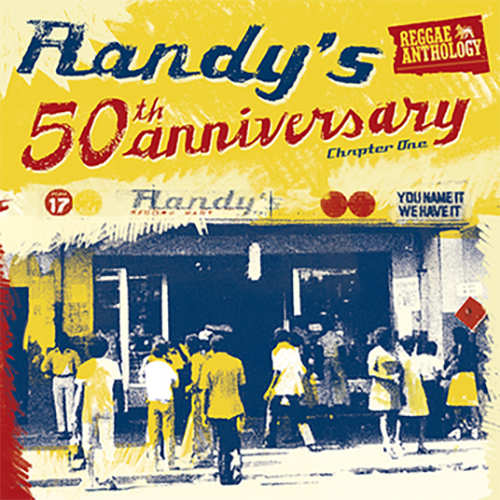
Review | Various – Randy’s 50th Anniversary: Reggae Anthology (Chapter One)
Back in the fall of 2008, VP Records’ imprint 17 North Parade celebrated fifty years of the legendary Randy’s Records with Randy’s 50th Anniversary, released only on CD at the time. Now, many years later, vinyl heads finally get their turn as the first disc from that set has been pressed to black wax.
The Foundation
This double LP follows the heartbeat of Jamaican music through the 1960s. You hear the shift from ska to rocksteady, and then into early reggae, all in one clean run. If you know these eras well, it’s a chance to reconnect with tunes and voices that helped build the foundation. But if you’re still learning, this record gives you a clear picture of what was coming out of Jamaica during the 1960s.
Side A
Things kick off with Independent Jamaica by Lord Creator, which brings us straight to 1962. Recorded at Federal Studios for Vincent “Randy” Chin, this calypso-styled song went on to become the official song of Jamaica’s independence. Lord Creator had been living on the island since 1959, and his role in shaping the early music scene can’t be overstated. Even with hits like this under his belt, many listeners still connect him most strongly with Kingston Town. Next up is Let Me Dream by Alton Ellis and Eddie Parkins, the final tune the pair recorded together before Parkins left for the US. Later, Alton would step out on his own and become one of rocksteady’s defining voices. Lord Creator returns to wrap up side A, first alongside Norma Fraser on We Will Be Lovers, a song he penned for her. He follows that with Don’t Stay Out Late, a hit that later resurfaced in the 1970s when Johnny Clarke cut his own version for Bunny Lee.
Side B
Make Hay takes us right back to the early days of Cornell Campbell. Recorded in 1963, it already shows that unmistakable high tenor that would later become his calling card. At the time, though, the song didn’t really catch on and quietly slipped under the radar. From there, the focus shifts back to ska. Charlie Organaire, whose harmonica you hear on Make Hay, follows with his own instrumental piece, Royal Charlie. Singer Joanne Gordon joins forces with Roland Alphonso on Blow Roland Blow, keeping the ska train rolling. And the ska mood continues with Portrait Of My Love, an instrumental version of the pop hit, delivered in fine style by trumpeter Baba Brooks. The Skatalites’ round off with an excellent adaptation of Lee Morgan’s jazz piece Malcolm X.
Side C
Alton Ellis’ Mouth A Massa feels like a natural next step after where The Skatalites left things. It keeps that same musical spirit alive, but it also opens the door to even more sweet ska moments on this third side. And from there, the selection just keeps getting better. You get one of Roland Alphonso’s early tunes, Run Bumpers, with Alton laying down smooth harmonies. Then there’s John & James by The Maytals, a top-tier early ska cut that still sounds fresh today. It’s paired nicely with Yagga Yagga from Delroy Byfield, a Rastaman who didn’t stick around long in music, but definitely left his mark here. Machine Shop reminds us how crucial Don Drummond was to the ska era. His trombone work and composing skills shine, and it’s easy to hear why he’s still talked about as one of the genre’s true giants. Home Home Home brings in Stranger Cole and Ken Boothe, who only recorded three songs together for Randy’s. This one is easily the strongest of the lot. And then Lord Creator steps back in with Such Is Life, a powerful tune drawn from his own experience after being jailed in the mid-’60s for ganja possession. You can really hear the music shifting here, moving out of rocksteady and edging toward early reggae.
Side D
The Wailers kick off the final selection of tunes in fine style with their 1969 take on Sugar Sugar, the pop hit made famous by The Archies. But this isn’t a straight cover. They slip in a verse from You Pour Sugar On Me, a tune Judy Mowatt would later record herself. Bob Marley handles the lead, backed by rich, confident harmonies from Peter Tosh, Bunny Wailer, and Rita Marley. It sounds tight, joyful, and unmistakably Wailers. Staying with the same camp, the next track is Peter Tosh’s You Can’t Fool Me Again. It’s one of his earliest solo sides, recorded at Randy’s new studio, and the message comes through loud and clear. Tosh already sounds focused and fearless, saying exactly what he means. The Gaylads follow with Wha She Do Now, and this is classic territory for the group. They always knew how to handle songs about love and relationships, and they do it effortlessly here. Then comes End Dust, a beautiful organ-led instrumental by the Impact All-Stars, with Jackie Mittoo right up front, recorded just before he left for Canada. Alongside the album closer, True Man by The Ethiopians from 1970, this tune stands as a strong example of early reggae taking shape.
For seasoned collectors, this release offers the rare pleasure of hearing classics again, while for newer listeners it serves as a clear guide to how the sound took shape.