
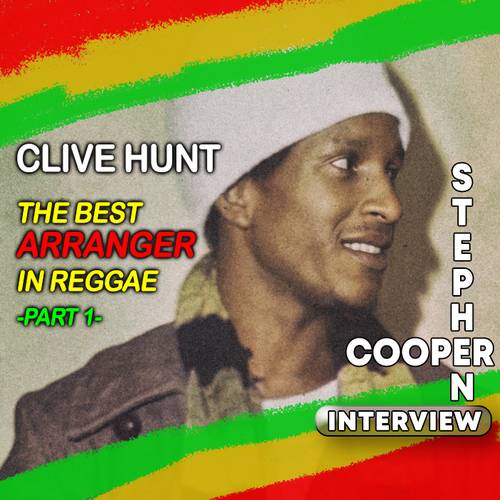
Interview with Clive Hunt (Part 1)
I did “Satta I”—the first song I ever wrote [where] I did reggae, was “Milk and Honey.” It was the first song I ever produced. When I went to the studio, I didn’t have a song, but it was just around the time when they say the Emperor Selassie died. I went to the mountain where my dad was with my brothers and sisters and his whole crew. And everybody’s face was like looking away. And then my dad asked me in front of everybody, “Say, hey Clive, you’re out in the world. What you say about this thing about Selassie being dead?” So I just gave my little speech on that, and then, when I went in the studio I wanted a song and I just sit at the piano. And I just start singing “Jah Jah bring forth honey, don’t stop. Jah Jah bring forth milk and honey, don’t stop. Let the newsmen write what they want to write.”
Yes.
“Let the wicked believe what they want to believe. Jah Jah bring forth honey, don’t stop.” That type of vibes there. Alpha Blondy told me that I made one mistake in life. Him say on my first recording, I said something in the song I shouldn’t have said. He said I say, “we don’t care for dunny,” which is money.
Oh my God, I was gonna ask you this exactly.
(Laughing)
This exact thing, Clive! That was the only part of the lyrics—that was the only part of the lyrics I didn’t know—which was “dunny”—and then I looked it up and [learned] that the Jamaican patois [for that word is] money or cash.
Yeah! (Laughing) So Alpha Blondy told me, “Mr. Hunt”—because you know I was the first one who bring him into a studio and recorded him.
Yes!
And he wasn’t called Alpha Blondy [then]. His name was Seydou Koné. K-o-n-e.
Yup.
Anyway, he told me, “Mr. Hunt, you can’t say that in the song! You put a spell on yourself.” Mi say, “Why? What you mean?” [He said]: “You should say, ‘And we want all of the money.’”
(Laughing)
(Laughing) Anyway, I was just being true to how I seen stuff—things around those times. Anyway, I just wrote the song and it became a hit! A massive [hit].
Yeah, I’m gonna come back to “Milk and Honey” because I have a number of questions about that [song]—
Okay. (Laughing)
—and also Dennis Brown. And I definitely have questions about Alpha Blondy, too. But let me ask you this—just to talk about the Lizzard album from ‘76—
Yes, yes.
—in general. Let me ask you two specific questions about that. First of all, did you write and sing—and also, I know Errol Brown was involved in being the engineer—
He was the engineer, yes.
And did you also play all the instruments on that ’76 album or were there other people involved?
No, only that song, [on “Milk and Honey”], I played most of the instruments, not all. Most. Because when I wrote the song, I booked the studio time. I paid for it. And I got the money from the drummer Mikey “Boo” Richards who was the drummer for the “Now Generation” band and the “In Crowd” band. We were all good friends. I was a part of that—those teams. So, anyway, I played the bass. And then I played the piano. Then I went over to the organ. It was a C3 organ. Then I went to do the percussion. But before I started all of that—when I went to the studio after paying—start to spend the money Mikey had given me to produce a song—he said “Clive”—he was trying to prove to me that I could produce a song. You know, they wanted me to produce. And I told him I didn’t think I was ready yet. He said, “What you mean!?” I said, “I don’t think I know enough.” He said, “Listen”—he let me walk to the bank with him, gave me one thousand Jamaican dollars, and he said: “Go produce a song.” And I just jump in a taxi. (Laughing) So anyway, when I went to the studio that day there was some gunshots firing down the road. Near Tivoli Gardens—right there, so, in that area. So nobody came to the studio. It was just me and Errol Brown there.
And the singer [of the original “Milk and Honey”] should have been Bunny Gayle, but he didn’t come. Right?
Yeah. It was [supposed to be] Bunny Gayle—I was thinking about Bunny Gayle initially, yes. He was my singer. You know, Peter Tosh told me a few years later that Bunny Gayle [was] his favorite reggae singer, you know?
Wow. Cool.
Yeah, he told [me] that around 1980. ‘81. We were hanging out together and he told me that. Anyway, yeah, so Bunny Gayle didn’t come. I don’t even remember seeing him. I’ve been asking for him recently. I don’t know what became of him. But anyway, he didn’t turn up. So I said to Errol, “Listen, I can start recording songs if I have a drummer.” And Errol say, “Yeah man. There’s a drummer here. And he introduced me to Fish Clark, which [is] Johnny Clark’s brother. The studio was on the third floor and he was [on] the balcony. So I just went outside [and] call[ed] him in. I didn’t know him. He didn’t know about—he might have known of me—because I was very famous as a young musician, you know? Like I was at every studio every day. Everybody wanted me to work. So anyway, he came and he did the drums and I played the bass. And I walked over to the piano. Did the piano. Then I did the organ. Then I did the percussions. I took up the guitar—no, I think [then] I sang the song. But I sang it just like it was a demo—I just sing it like it’s no special performance. I just sing it. So anyway, I went to put the guitar now, and when I started playing the guitar, Karl Pitterson—you know Karl Pitterson?