
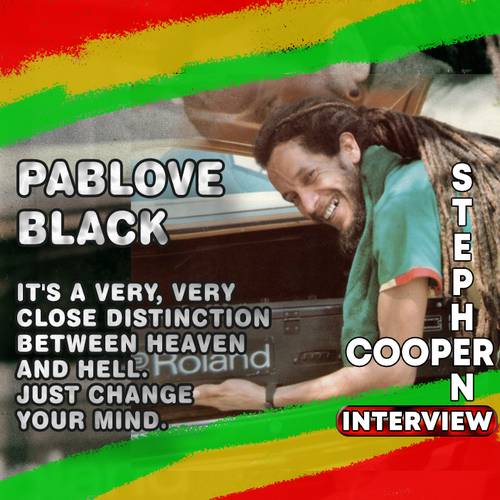
A Rastafarian member of The Twelve Tribes of Israel, Black played on many big hits by legendary singers from Studio One, and at times, sang background vocals too. Black also played on countless other songs with legendary artists—including even Bob Marley—at other famous studios in Jamaica as well, studios like legendary producer Lee “Scratch” Perry’s Black Ark. On top of that: Black recorded and toured the world with the late iconic reggae singer Jimmy Cliff.
On February 16, I was blessed to interview Pablove by phone for over 2 hours; I was in Los Angeles and Pablove was in Florida where he lives. What follows is a transcript of roughly the first 75 minutes of the interview, modified only slightly for clarity and space considerations; this roughly 10,000-word conversation is Part 1 of my irie and historic reasoning with Pablove. Embedded throughout the transcript are links to music, exclusive photos, and more. At the end, please also find a link to the audio file of Part 1 of the interview—available on YouTube.
Hello? Greetings, Pablove.
Greetings, my brother.
How are you?
Alright. And you?
I’m doing good but I do want to let you know that where I am in Los Angeles, it’s raining cats and dogs.
Yeah.
And so the rain is coming down pretty loud. So I have to ask you if you can to keep your voice up as loud as you can. I have my audio recorders on and they’re running. And I have them positioned right by the phone but I want to still encourage you to speak loudly so that everything that you say can be captured for posterity.
Sure. Is the way I’m talking now okay?
Yeah and can you hear me well? Can you hear me loud and clear?
Yeah man.
Okay, good. Well Pablove, I want to begin this reasoning by saying thank you so much for taking the time today to speak with me for Reggae-Vibes. It is a profound honor to be able to speak with a legendary Jamaican musician like yourself who played such an important and instrumental role in the development and success of reggae worldwide.
Thanks man.
In addition to your solo work, Pablove, including your two classic solo albums, “Mr. Music” in 1979 and “Charcoal Charlie” in 1986—both of which I’m gonna ask you about today—you have, Pablove, I just want to say by way of introduction: I know that, primarily with your legendary keyboard playing skills but also with your mastery of a lot of different instruments, including the melodica, the piano, the organ, the steel drum, and also with your voice, that you have contributed to some of reggae’s biggest hit tunes with the topmost stars. And I was really impressed I have to say, [because] it’s no exaggeration, when I was looking at all the different people that you have recorded songs with—that you have done work with, Pablove—my mind was blown. And I had to very selectively—because I know that I won’t be able to talk to you all day long and all night long, and on and on and on—so I had to very selectively choose, you know, who [and what artists and songs] I’m gonna ask you about today. But with your permission, I do just want to very quickly mention a number of these names that I saw when I was going through all of your different credits for different music. And some of the names I saw included: Jimmy Cliff, Dennis Brown, Burning Spear, Freddie McGregor, Fred Locks, Marcia Griffiths, Abyssinians, Hugh Mundell, Toots & The Maytals, The Royals, I-Roy, U-Roy, The Gladiators, Johnny Osbourne, Peter Broggs, Sugar Minott, The Meditations, Judy Mowatt, Brigadier Jerry, Mikey Dread, Yabby You, Joe Higgs, Sister Carol, Pinchers, Beres Hammond, I Kong, Mafia & Fluxy, Winston Francis—and I could go on and on as you know. There are a lot of names I didn’t even mention.
(Laughing)
Yeah (Laughing). It’s a very, very impressive list. But Pablove, before we can get into your historic contributions at places like Coxsone’s Studio One and Lee “Scratch” Perry’s Black Ark Studio, it’s important I think for all your fans to first understand a little bit your background and your personal history—about which not much is known. And if it’s okay, I want to start off by confirming with you just some basic facts about yourself. Is it true that you were born on United Nations Day—which is October 24th—1950, in Kingston, Jamaica?
Yes, that’s correct.
Okay, good. And the internet tells me that your legal name is Paul Anthony Dixon. But I think many people would like to know right from the jump possibly, how did you get that stage name “Pablove [Black]?”
Well I’m gonna tell you. You know it was as a result of the 60s, after the Black Power Movement, and we started to identify ourselves in our Black cultural sphere.
Yeah. Did you choose that name?
Yeah, because I wanted to find a name where I could represent myself with—I think it’s a painter or a poet named “Pablove.” Even [at] Studio One it did cause a problem with the spelling in the first place.
Oh wow. I was gonna ask you—and I might as well ask you now: On your first [solo] album which we’re gonna talk about, on the very front of the album, I don’t know if it’s by coincidence or not—or maybe it’s because of what you’re saying—it’s interesting because it says very close up, if you were to open up the album cover or maybe it’s on the back [cover]. There’s a profile of you—
Yeah.